The Curse and Legends: The Stone That Brings Bad Luck to Men
Every famous diamond has a curse, and the Kohinoor's is the most famous of all: it is said to bring bad luck — even death — to any man who owns it, while women may wear it safely. The story is told in guidebooks, in newspapers, and in the Tower of London itself. It is also, as far as anyone can tell, untrue. This guide separates the legend from the history: where the curse story came from, what it gets wrong, and why it has lasted so long — along with the other legends that have grown around the stone, from hidden jewels to ancient gods.
In short
The legend says the Kohinoor brings misfortune to any man who owns or wears it, and that only women can wear it safely. Since arriving in Britain, it has indeed only been worn by female members of the royal family. But there is no evidence for a curse: the male rulers who owned the stone lived in violent times, and many of them died violently for reasons that had nothing to do with a diamond. The curse story is a legend — an old one, and a persistent one — not a fact. The same is true of the other stories in this guide, which are labelled as legends wherever they appear.
Where the curse came from
The curse legend is usually traced to a Hindu text, and to the idea that the stone was once the eye of a god, or a sacred object that punished those who stole it. The details vary with the telling: in some versions the curse falls on any man who owns the stone; in others it falls only on a man who wears it; in others still it brings bad luck to a whole dynasty. The common thread is that the stone is dangerous to men and safe for women — a neat explanation for the fact that, since 1850, it has been worn only by queens. The story was already old by the time the British acquired the stone, and it was repeated eagerly by Victorian newspapers, who loved a good curse story almost as much as they loved a good diamond.
The evidence for the curse is a list of men who owned the stone and came to bad ends: Nadir Shah was assassinated; Ahmad Shah Durrani's empire fell apart; Ranjit Singh's sons were murdered one after another; Duleep Singh lost his kingdom as a child. It is an impressive list — until you remember that these men lived in the eighteenth and nineteenth centuries in South and Central Asia, where rulers were routinely assassinated, empires routinely collapsed, and royal successions routinely ended in murder. The Kohinoor's owners were not unlucky by the standards of their time; they were typical. And the list leaves out the men who owned the stone and died peacefully in their beds, and the women who owned it and suffered — because the legend is told backwards, from the deaths to the diamond, rather than forwards, from the diamond to the deaths.
The queens who wore it
What is true is that, since the stone arrived in Britain, it has only been worn by women. Queen Victoria wore it as a brooch. Queen Alexandra wore it in her crown. Queen Mary wore it in hers. Queen Elizabeth the Queen Mother wore it in hers. The tradition is sometimes presented as a precaution against the curse — the royal family, it is said, will not let a man wear the stone — but it is also simply the result of how the Crown Jewels work: the Kohinoor has been set in queens consort's crowns, and kings are crowned with different crowns. The tradition was tested, in a way, at the coronation of Charles III in 2023: the question was whether Queen Camilla would wear the Queen Mother's crown, with the Kohinoor in it. She did not. She wore Queen Mary's crown, reset with other diamonds, and the Kohinoor stayed in its case. The decision was widely read as a diplomatic one — a way of avoiding a row with India on coronation day — rather than a matter of superstition, but the curse story was repeated in every newspaper that covered it.
The Hope Diamond: a cautionary parallel
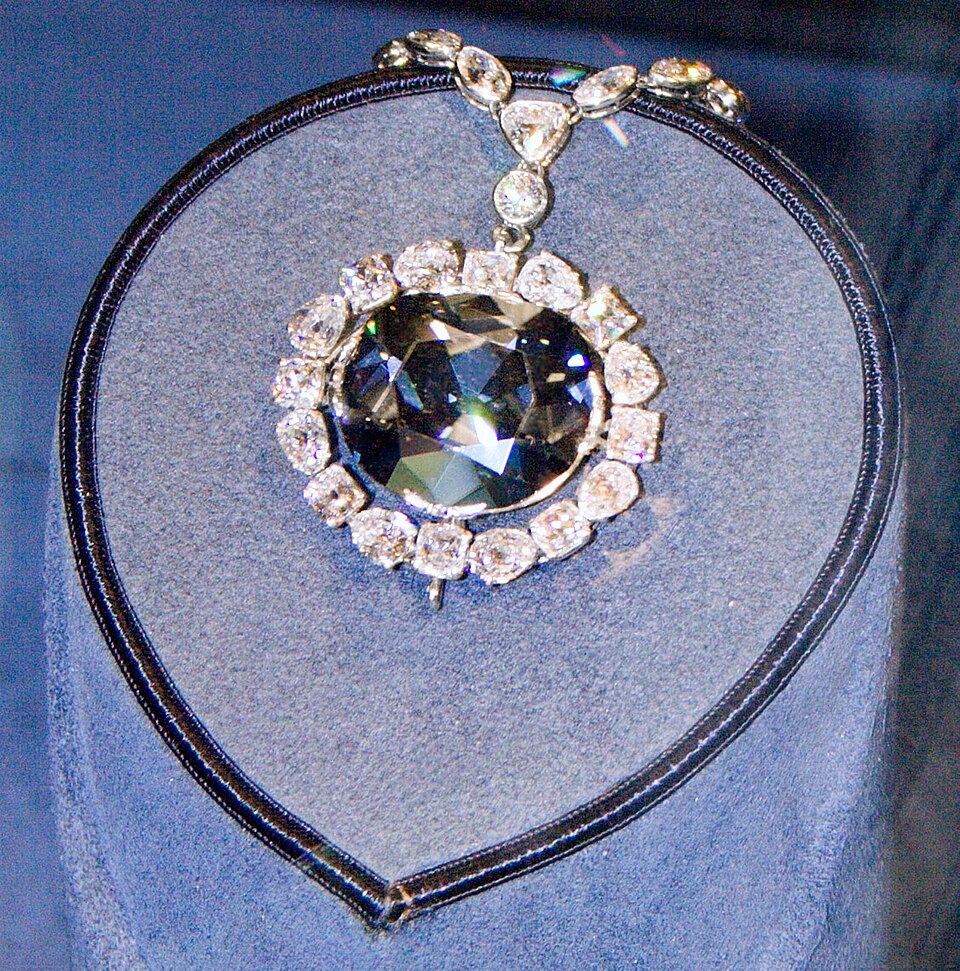
The Kohinoor is not the only famous diamond with a curse story, and the parallel is instructive. The Hope Diamond — a 45.52-carat blue diamond, now at the Smithsonian in Washington — is said to bring bad luck to its owners, and its history is full of suicides, bankruptcies, and murders. The Smithsonian, which has held the stone since 1958, is blunt about the story: the evidence linking the Hope to its supposed original owner, the French merchant Tavernier, is circumstantial, and the curse itself is a newspaper invention, built up in the early twentieth century to sell papers. The Hope's curse and the Kohinoor's curse have the same shape: a famous stone, a string of unhappy owners, and a story that grows more detailed with every retelling. In both cases the curse tells us more about the people who tell the story than about the stone.
Other legends
The curse is not the only legend attached to the Kohinoor. There is the story of the turban — that Nadir Shah obtained the stone by swapping turbans with the Mughal emperor — which is almost certainly untrue, and which is covered in the Nadir Shah guide. There is the story that the stone was the eye of a Hindu goddess, stolen from a temple in southern India — a story also told about the Orlov diamond, and probably a piece of folklore rather than fact. There is the claim that the stone is the Syamantaka, a jewel mentioned in ancient Sanskrit texts, and that it is more than five thousand years old — a claim with no reliable evidence behind it. And there is the story that Shah Jahan, imprisoned in Agra Fort, had the stone placed against a window so that he could see the Taj Mahal reflected in it — a beautiful story, and almost certainly invented.
None of this means the legends are worthless. Legends are part of the diamond's history too: they are what people believed, and what they still believe, and they have shaped how the stone is displayed, written about, and argued over. But a site that calls itself "Decoded" has to say which stories are supported by evidence and which are not. The rule this site follows is simple: a story is presented as fact only when the sources support it; everything else is labelled as a legend, a story, or a claim — and the reader is left to make up their own mind.
Why the curse lasts
The curse lasts because it does useful work. For those who want the diamond returned, it is a reminder that the stone has brought nothing but trouble to its owners — a moral argument dressed as a supernatural one. For those who want it kept in London, it is a reason why the stone is worn only by queens, and a piece of colour that makes the Crown Jewels more interesting. For the newspapers, it is a headline that writes itself. And for the rest of us, it is a good story — the kind of story that attaches itself to any object that is old enough, famous enough, and fought over enough. The Kohinoor is all three, and the curse is part of its fame. It is not, as far as anyone can show, part of its history.
| Legend | What is claimed | What the evidence says |
|---|---|---|
| The curse | Bad luck or death for any man who owns or wears the stone | No evidence; owners lived in violent times and died violently for ordinary reasons |
| The turban trick | Nadir Shah got the stone by swapping turbans with the emperor | Almost certainly untrue; the stone was set in the Peacock Throne |
| The goddess's eye | The stone was stolen from the eye of a Hindu goddess | Folklore; the same story is told about the Orlov |
| The Syamantaka | The stone is a jewel from ancient Sanskrit texts, 5,000 years old | No reliable evidence |
| The Taj reflection | Shah Jahan saw the Taj reflected in the stone from his prison | Beautiful, almost certainly invented |
Sources: Wikipedia, “Koh-i-Noor”; World History Encyclopedia, “Koh-i-Noor”; Smithsonian Institution, on the Hope Diamond curse; Erebaur, “Famous stones & historic jewels.” Checked 29 November 2026.